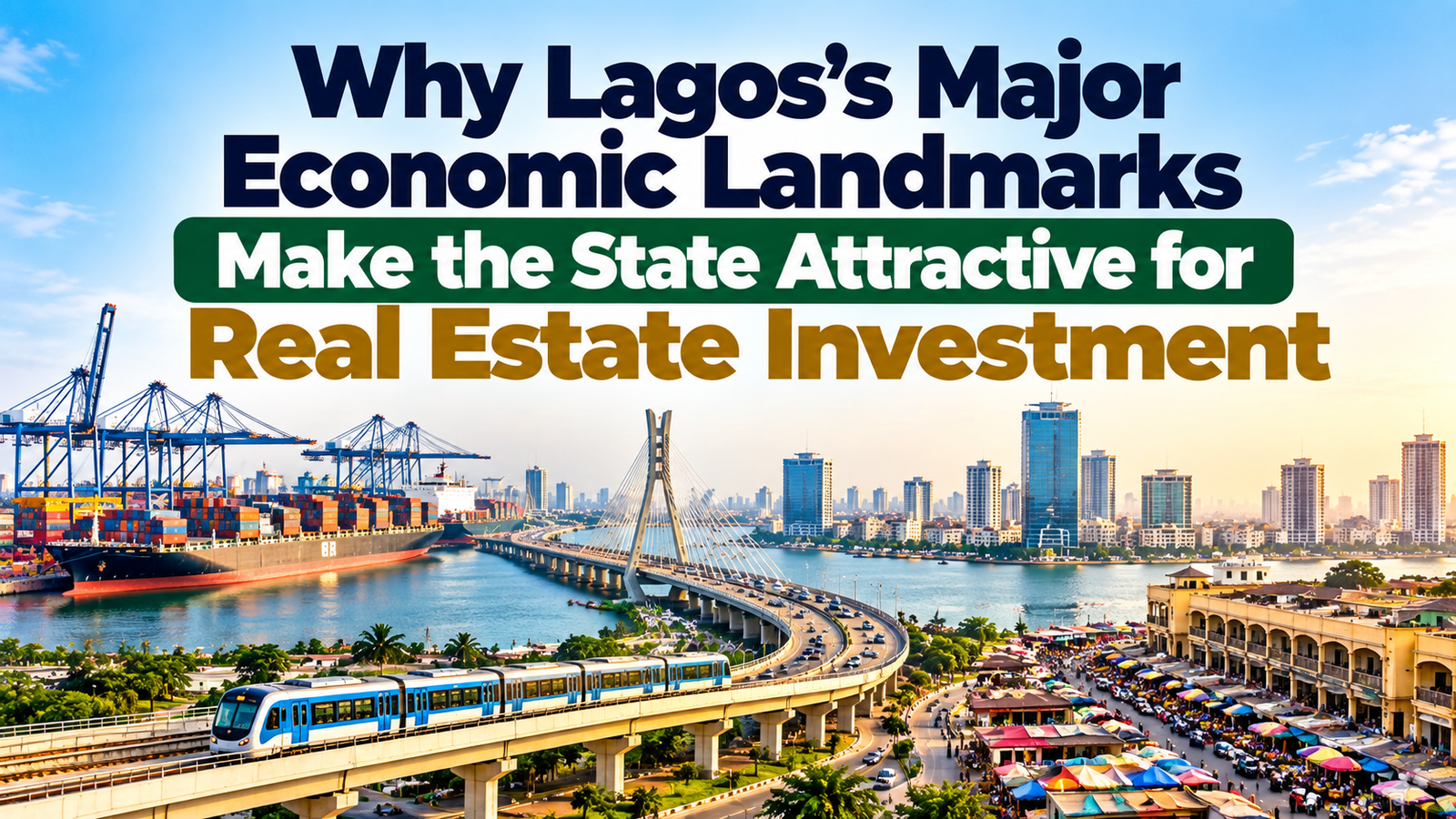
Why Lagos’s Major Economic Landmarks Make the State Attractive for Real Estate Investment
When people talk about investing in Lagos real estate, the conversation often focuses on property prices, rental income and the potential of future appreciation. But there is another important question worth asking: What is happening around the property?
Real estate does not exist in isolation. People need somewhere to live because they work, trade, study, operate businesses and provide services. Businesses need offices, shops, warehouses and other commercial spaces. Workers need housing close enough to their places of employment.
This is one reason Lagos continues to attract attention from property investors. The state is home to major markets, financial districts, industrial facilities, ports, transportation projects and large-scale developments that create economic activity and, in turn, demand for real estate.
So, what are some of the landmarks and economic activities helping to shape Lagos’s property market?
Lekki Deep Sea Port and the Growth of the Lekki Corridor
One of the most significant developments influencing the eastern part of Lagos is the Lekki Deep Sea Port.
The port is integrated with the wider Lekki Free Zone and provides maritime access for businesses operating in the area. The Lagos Free Zone says the port has a 1,200-metre quay, three container berths and capacity to handle up to 2.5 million TEUs annually.
Why does this matter to real estate?
Ports create demand beyond the port itself. Workers, logistics companies, manufacturers, suppliers, retailers and service businesses all need space to operate. That can translate into demand for warehouses, offices, shops, hotels and residential accommodation.
This is one reason investors are paying attention to areas around Ibeju-Lekki, Lekki and the wider Lekki-Epe corridor.
Dangote Refinery and the Industrial Expansion of Lekki
Another major landmark is the Dangote Refinery, located within the Lekki Free Zone.
The Oil and Gas Free Zones Authority describes the Dangote industrial zone as a major energy and industrial development containing the refinery, fertilizer and petrochemical facilities. It is strategically located close to the Lekki Deep Sea Port.
Large industrial developments can influence surrounding real estate because they create an ecosystem of workers, contractors, suppliers and businesses.
As industrial activity expands, demand can emerge for accommodation, logistics facilities, commercial spaces and services.
For a property investor, this demonstrates why it is important to look at economic activity surrounding a location, not just the property itself.
Alaba International Market
Lagos’s real estate story is not only about billion-naira infrastructure projects.
Markets are also powerful economic landmarks.
Alaba International Market in Ojo is a significant centre for electronics and technology-related trade. In 2026, the Federal Ministry of Information described Alaba as one of Africa’s prominent centres for electronics and technology, following the unveiling of its transformed commercial facilities.
Thousands of traders, employees, customers, suppliers and service providers depend on the wider commercial ecosystem around the market.
That activity can create demand for shops, warehouses, offices, restaurants, accommodation and residential properties.
The ongoing redevelopment of the market also illustrates how improvements to commercial infrastructure can affect the surrounding environment. The Lagos State Government has linked the redevelopment to improving the market’s facilities and economic activity, while access-road improvements remain an important issue.
For investors, Alaba is a useful example of how commerce can support real estate demand.
Balogun Market and the Commercial Power of Lagos Island
Move to Lagos Island and you encounter another major economic engine: Balogun Market and the surrounding commercial district.
Lagos Island has historically been a centre of commerce and remains home to major markets including Balogun, Idumota, Isale Eko and Oke Arin. The local government describes the area as one of Nigeria’s most active commercial environments, with markets, financial institutions and business districts operating alongside one another.
This concentration of commercial activity creates a large daily population of traders, workers, customers and service providers.
For real estate, that population matters.
Commercial activity can support demand for retail spaces, offices, storage facilities, short-term accommodation and residential properties in accessible surrounding areas.
At the same time, investors need to pay attention to building quality, planning regulations, congestion and redevelopment plans. Lagos State has previously ordered regeneration and professional assessment of buildings around parts of Balogun Market following safety concerns.
Eko Atlantic and the Expansion of High-End Real Estate
Another landmark changing the Lagos skyline is Eko Atlantic.
The development is a large planned coastal city on Victoria Island, with dedicated infrastructure including roads, drainage, water treatment and power facilities.
Projects such as Eko Atlantic demonstrate another side of Lagos’s real estate market: large-scale mixed-use and premium developments designed to attract businesses, residents and investment.
Its significance goes beyond the buildings inside the development. Major projects of this scale can contribute to the wider attractiveness of surrounding areas and strengthen Lagos’s position as a destination for high-value commercial and residential activity.
Rail and Transport Infrastructure
Transportation is another major factor investors should watch.
Lagos has invested heavily in mass transit infrastructure, including the Blue Line and Red Line rail projects. The Red Line is designed to connect parts of the mainland with Lagos Island, while the Blue Line provides a rail connection between Mile 2 and Marina.
Why does transportation matter to real estate?
Accessibility influences where people are willing to live and where businesses choose to operate.
A neighbourhood that becomes easier to reach can become more attractive to residents and businesses. This does not mean every property near a transport project will automatically increase in value, but improved connectivity can be an important factor when assessing a location.
The Bigger Picture for Real Estate Investors
The interesting thing about Lagos is that these developments do not operate separately.
A port supports logistics. Logistics supports businesses. Businesses require workers. Workers need housing. Businesses need offices and commercial space. Increased activity creates demand for transportation, hospitality, retail and other services.
This creates a network of economic activity that can influence real estate demand across different parts of the state.
Agusto & Co.’s 2026 Lagos real estate report similarly identifies infrastructure-led appreciation and the concentration of major investments along the Lekki-Epe corridor as important forces shaping the market.
Does This Mean Every Property in Lagos Is a Good Investment?
No.
This is an important distinction.
The presence of a major market, port, refinery or infrastructure project does not automatically make every nearby property a profitable investment.
Investors still need to investigate land ownership, title documents, accessibility, flooding risks, zoning, development restrictions, purchase prices, rental demand and the cost of maintaining the property.
A location can have enormous economic activity and still contain properties that are overpriced or poorly positioned.
The smarter approach is to ask what economic activity is driving demand, who needs property in the area and whether the price makes financial sense.
Final Thoughts
Lagos has something that many real estate markets would struggle to replicate on the same scale: a combination of population, commerce, industry, transportation, financial activity and major infrastructure projects.
From the Lekki Deep Sea Port and Dangote Refinery to Alaba International Market, Balogun Market, Eko Atlantic and the state’s expanding transport network, these landmarks help explain why real estate remains closely connected to the wider Lagos economy.
For investors, the opportunity is not simply to buy property because a major project exists nearby. The real opportunity is understanding how that project creates jobs, attracts businesses, brings people into an area and generates demand for space.
That is where the connection between Lagos’s economic growth and its real estate market becomes particularly interesting. Visit adicsblogs for more real estates updates